|
We have been helping growers and researchers measure soil moisture since 1951, and offer two proven, effective, and well researched methods for measuring soil moisture. The original "IRROMETER" instrument was the first commercially viable Tensiometer available, and is still the standard by which other methods are tested. Our IRROMETER instruments provide a direct measurement of soil water tension, which is the tension all root systems must overcome to extract water from the surrounding soil. Simple, reliable, and accurate, the IRROMETER is still the choice of many successful growers and consultants. Our next option for soil moisture measurement is the WATERMARK sensor. This Granular Matrix Sensor (GMS) offers low cost, accurate readings, and easy integration with electronic reading equipment. First introduced in 1979, the WATERMARK sensor has grown in popularity and gained acceptance worldwide for reliability and accuracy in measuring soil moisture. For over two decades, the WATERMARK sensor has been utilized in numerous research studies around the world. Resources: IRROMETER Reference Manual Agriculture Design Guide IRROMETER Catalog Irrigation Monitoring Using Soil Water Tension (OSU) IRROMETER Soil Moisture Basics For more IRROMETER and WATERMARK sensor document downloads, click here |
Read about IRROMETER technology at work helping Afghan farmers |
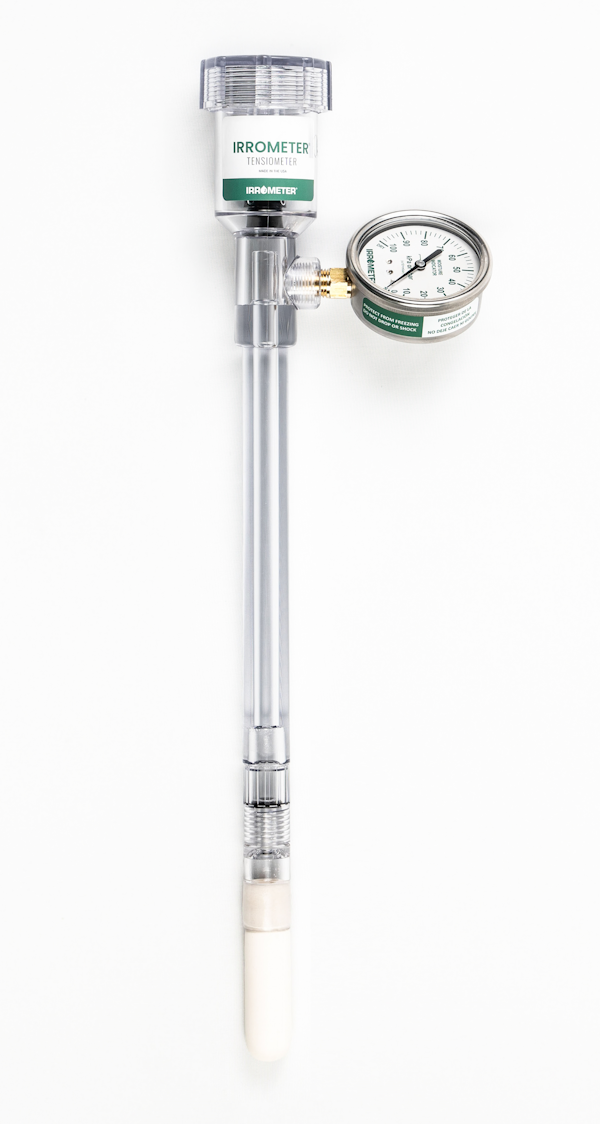
The IRROMETER Tensiometer is the standard in accurate soil moisture measurement,
offering growers an inexpensive and reliable means of measuring soil
moisture for irrigation scheduling. An IRROMETER will measure
the actual soil water tension, which indicates the effort required by
root systems to extract water from the soil. Because the
IRROMETER is a true measurement of soil water potential, the instrument
is not affected by salinity and does not require site calibration.
The IRROMETER is available in several models, with standard lengths of 6", 12", 18", 24", 36", or 48" dependent on the rooting depth of the specific crop. Longer lengths are available by request.
"Please note that for every new set of Irrometers you will need a Service Unit"
The IRROMETER is available in several models, with standard lengths of 6", 12", 18", 24", 36", or 48" dependent on the rooting depth of the specific crop. Longer lengths are available by request.
"Please note that for every new set of Irrometers you will need a Service Unit"
|
The IRROMETER Model "R" is the standard one-piece IRROMETER for general use with row, tree, and field crops. Includes reservoir, air free gauge chamber and hermetically sealed IRROMETER vacuum gauge with dual scale of centibars and kilopascals (0-100 cb [kpa] range) Model R Specification Document The IRROMETER Model "SR" has a threaded replaceable tip as well as all the features of the Model R above. Includes reservoir, air free gauge chamber and hermetically sealed IRROMETER vacuum gauge with dual scale of centibars and kilopascals (0-100 cb [kpa] range) Model SR Specification Document The IRROMETER Model "S" - has a threaded connection at the top of the tube. Designed for research work where change in instrument length is required for different experiments, and or general use with row, tree, and field crops. When ordering, select Extention Tip(s) in combination with the Reservoir Selection. Includes reservoir, air free gauge chamber and hermetically sealed IRROMETER vacuum gauge with dual scale of centibars and kilopascals (0-100 cb [kpa] range) Model S Specification Document The IRROMETER Model "P" (Portable) - Unlike other model IRROMETERs which are intended for permanent installation, the Model “P” is designed to be installed in a temporary situation so that the user can make a “spot check” of soil water tension and then relocate the instrument to other locations. Each site reading may take from minutes to hours, depending on soil conditions. Includes reservoir, air free gauge chamber and hermetically sealed IRROMETER vacuum gauge with dual scale of centibars and kilopascals (0-100 cb [kpa] range) Model P Specification Document The IRROMETER Model "LT" (low tension) - is designed for situations where tensions above 30 cb (kPa) are rarely expected. Ideal for very coarse soils and non-soil container-media or where rapidly changing soil water status needs to be observed. Incorporates a replaceable Quick-Flo tip (blue color), and low tension vacuum gauge (40 cb). Includes reservoir, air free gauge chamber and hermetically sealed IRROMETER vacuum gauge with dual scale of centibars and kilopascals (0-40 cb [kpa] range) Model LT Specification Document The IRROMETER Model "MLT" (Miniature Low Tention) - designed for appications similar to the Model "LT" above. Ideal for use with very coarse soils and non-soil container-media. Its compact size and replaceable "Quick-Flo" tip make it the best choice for green house applications. Model MLT Specification Document The IRROMETER Model "TG" - for shallow rooted applications such as turf, where installation requires horizontal placement of the sensing tip. Includes reservoir, air free gauge chamber and hermetically sealed IRROMETER vacuum gauge with dual scale of centibars and kilopascals (0-100 cb [kpa] range) The IRROMETER "Automation and Output Options" for the IRROMETER tensiometers are Gauges and or Transducers for direct switching capabilities. These options provide automation for irrigation valves and electronic output for use with automatic data collection systems. They can be added at the factory when purchased or added to your exsisting instruments in the field (as accessory items). Automation and Output Options for the IRROMETER Quick installation guide for your new IRROMETER IRROMETER Tensiometer Reference Book For further documentation information regarding the IRROMETER Tensiometers, please click here |
Field installation of two Model "R" IRROMETER's
IRROMETER Model SR with an "E" Gauge option |
In use since 1978, the patented WATERMARK sensor is a solid state electrical resistance sensing
device that is used to measure soil water tension. As the tension changes with
water content the resistance changes as well. That resistance can be measured using the WATERMARK Sensor.
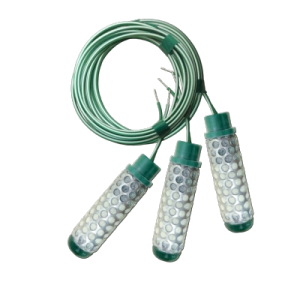
The sensor consists of a pair of highly corrosion resistant electrodes that are imbedded within a granular matrix. A current is applied to the WATERMARK to obtain a resistance value. The WATERMARK Meter or WATERMARK Monitor correlates the resistance to Centibars (kilopascals) of soil water tension.
The WATERMARK is designed to be a permanent sensor, placed in the soil to be monitored and “read” as often as necessary with a portable or stationary device. Internally installed gypsum provides some buffering for the effect of salinity levels normally found in irrigated agricultural crops and landscapes.
The sensor consists of a pair of highly corrosion resistant electrodes that are imbedded within a granular matrix. A current is applied to the WATERMARK to obtain a resistance value. The WATERMARK Meter or WATERMARK Monitor correlates the resistance to Centibars (kilopascals) of soil water tension.
The WATERMARK is designed to be a permanent sensor, placed in the soil to be monitored and “read” as often as necessary with a portable or stationary device. Internally installed gypsum provides some buffering for the effect of salinity levels normally found in irrigated agricultural crops and landscapes.
|
WATERMARK 200SS Features: In use since 1978, the patented WATERMARK sensor is a solid-state electrical resistance sensing device that is used to measure soil water tension. As the tension changes with water content the resistance changes as well. That resistance can be measured using the WATERMARK Sensor. The sensor consists of a pair of highly corrosion resistant electrodes that are imbedded within a granular matrix. A current is applied to the WATERMARK to obtain a resistance value. The WATERMARK Meter or Monitor correlates the resistance to centibars (cb) or kilopascals (kPa) of soil water tension. The WATERMARK is designed to be a permanent sensor, placed in the soil to be monitored and “read” as often as necessary with a portable or stationary device. Internally installed gypsum provides some buffering for the effect of salinity levels normally found in irrigated agricultural crops and landscapes.
200SS Specification Document For a Watermark installation video please click here For further documentation information regarding the WATERMARK 200SS Sensor, please click here WATERMARK Meter Features: Solid state, hand-held, alternating current resistance bridge meter for reading "standard" 200SS WATERMARK sensors. Adjustable for soil temperature variations. Touchpad operating panel with LCD display. The WATERMARK Meter includes:
WATERMARK Meter Specification Document WATERMARK Meter Instruction Manual For further documentation information regarding the WATERMARK Meter, please click here WATERMARK 200SS-VA (Voltage Adapter) Features: The WATERMARK sensor can be read by a voltage output adapter (200SS-VA) for easy integration with electronic systems. In addition to all of the standard sensor features, this version includes:
200SS-VA Specification Document 200SS-VA Instruction Manual 200SS-VA Voltage to Centibar (kPa) Calibration For further documentation information regarding the WATERMARK 200SS-VA voltage adapter, please click here |
WATERMARK Meter at work in the field
|